
Hey folks,
How are you all doing?
Recently, I was teaching a guitar improvisation lesson, and we were focusing heavily on how to solo over a 12-bar blues (the classic I-IV-V chord progression).
If you are just getting into lead guitar and improvisation, the 12-bar blues is hands-down the best training ground. Because the chord progression is structured and predictable, it gives your brain precious time to think. Instead of rushing, you can actually anticipate the upcoming chord changes, map out your scales, and focus on landing the right target notes at the exact right moment.
But here is the secret to becoming a great blues player: You can’t just practice the scales; you have to immerse yourself in the music. To help my students develop their phrasing and “blues feel,” I put together a list of masterclass recordings. Whether you are looking for inspiration for your next solo or just want to spin some incredible music, here is my definitive list of the best blues albums and tracks of all time.
1. B.B. King – Live at the Regal (1965)
My absolute number one favorite blues album of all time. If you haven’t listened to this record from start to finish, stop what you are doing and put it on right now.
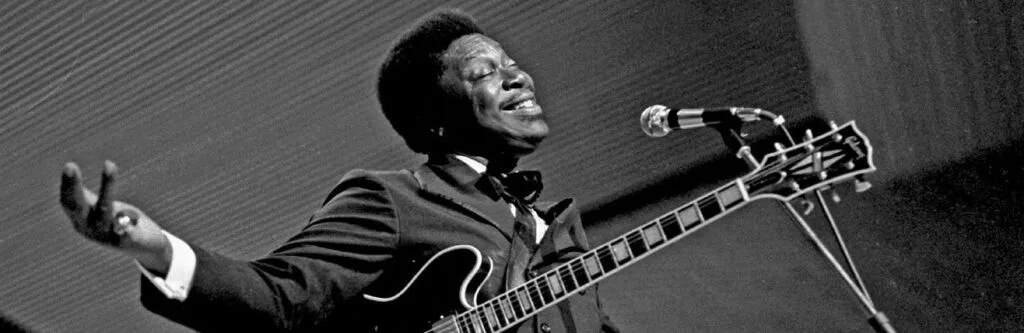
Live at the Regal is an absolute powerhouse of a performance. The sheer control B.B. King has over both his band and the audience is mesmerizing. His complete mastery of his guitar, Lucille, defines what blues phrasing should be—fewer notes, but maximum emotional impact. On top of that, his vocals are soaring and powerful. As a bonus, his spoken-word monologues between songs act like a mini time capsule, transporting you straight to a Chicago theater in 1964.
2. Freddie King – The Texas Blues Master
You cannot talk about blues guitar improvisation without talking about the “Texas Cannonball,” Freddie King. Freddie’s style was vastly different from B.B. King’s; he possessed a driving, aggressive attack, often using plastic thumbpicks and metal fingerpicks to get a sharp, biting tone. Tracks like “Hide Away” and “The Stumble” are essential listening for any guitarist trying to learn how to weave catchy melodies into a 12-bar blues framework.
3. Junior Wells’ Chicago Blues Band Featuring Buddy Guy – Hoodoo Man Blues (1965)
This album is widely considered one of the first and greatest examples of a deliberate Chicago blues studio album. The chemistry between harmonica player Junior Wells and a young Buddy Guy on guitar is electric. Buddy Guy’s guitar work here is raw, innovative, and deeply influential. If you want to learn how a guitarist can perfectly comp (accompany) a vocalist and a harmonica player before stepping up to deliver a blistering solo, this is the album to study.
4. Howlin’ Wolf – “Smokestack Lightning”
Howlin’ Wolf possessed one of the most uniquely gritty, primal, and haunting voices in music history. While the original studio version of “Smokestack Lightning” is an absolute classic, there are several live and alternative versions out there that capture a completely different, hypnotic energy. Pay close attention to Hubert Sumlin’s guitar work on Wolf’s tracks—his quirky, finger-picked riffs laid the blueprint for modern rock and blues guitar.
5. John Mayall & The Bluesbreakers – Blues Breakers with Eric Clapton (1966)
Affectionately known by guitarists as “The Beano Album,” this record shifted the landscape of British blues-rock forever. Incredible fact: Eric Clapton was only 20 years old when he recorded this! His playing on tracks like “Hideaway” and “All Your Love” introduced the world to the revolutionary tone of a Gibson Les Paul plugged into a cranked Marshall amplifier. It’s a masterclass in fiery, fluent blues scales.
6. Stevie Ray Vaughan – “Pride and Joy” (from Texas Flood, 1983)
Fast forward to the 1980s, and Stevie Ray Vaughan single-handedly revitalized the blues genre. “Pride and Joy” is the ultimate example of a driving Texas shuffle. SRV combined massive heavy-gauge strings, fierce down-strokes, and unmatched passion to create a wall of sound. If you want to learn how to play blues with explosive energy and perfect rhythmic timing, Stevie is your man.
How Listening Improves Your Guitar Soloing
When you listen to these legends, try not to just hear the music passively. Listen actively. Ask yourself:
How do they build tension during a solo?
How do they leave “space” or pauses between their musical phrases?
How do they change their volume (dynamics) when the singing stops?
By absorbing the phrasing of the greats, you’ll find that your own 12-bar blues soloing will start to sound less like a scale exercise and more like a real story.
Over to You: What’s Your Essential Blues Album?
So, go have a listen to these tracks, pick up your guitar, and start jamming!
But before you go, I want to hear from you. Did I miss your favorite artist? What do you think is the best blues album of all time?
Let me know in the comments below! “See” you soon,
Simon