
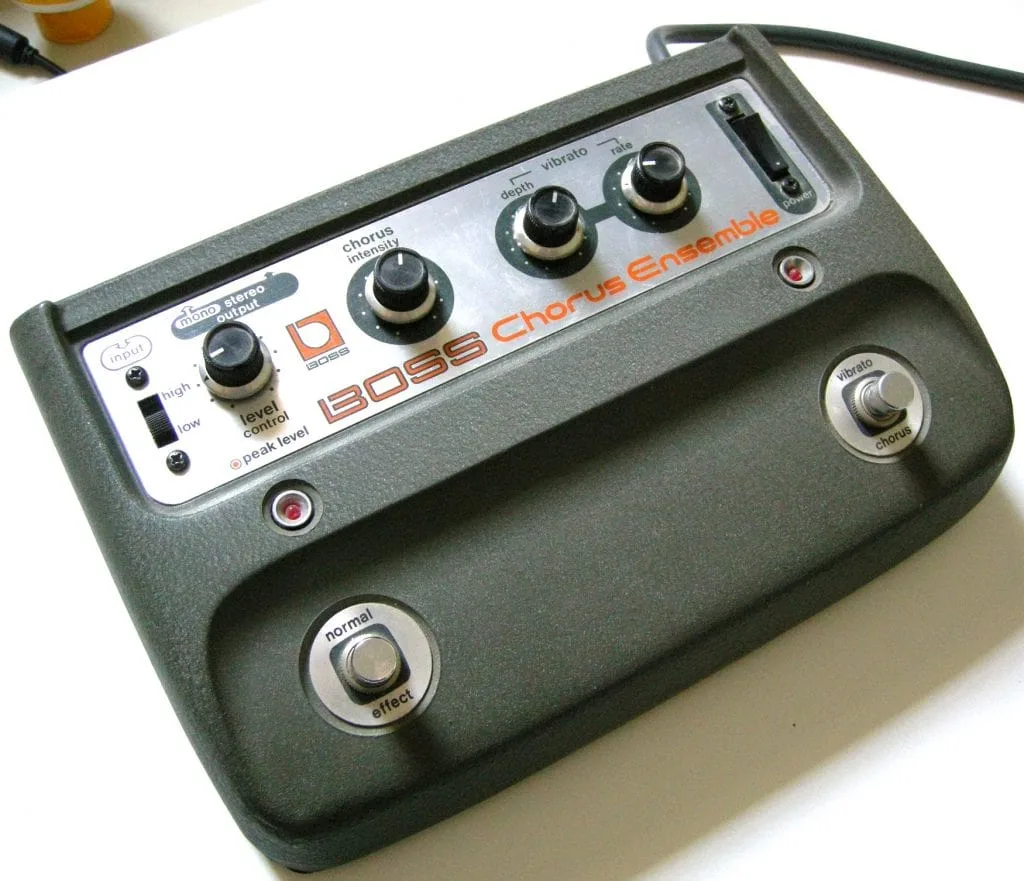
The chorus effect is one of the most recognisable sounds in guitar history — and one of the most misunderstood.
Used well, it adds shimmer, depth, and motion to your tone. Used poorly, it turns everything into a warbly, seasick mess. Here’s what you need to know.
How Does a Chorus Pedal Work?
A chorus takes your guitar signal and duplicates it. The duplicate is then slightly detuned and delayed — typically by 20–30 milliseconds — before being blended back with the original.
The result mimics the natural inconsistencies you’d hear from multiple instruments playing the same part together. It’s where the name comes from: a chorus of instruments, not one.
Key parameters on most chorus pedals:
- Rate — how fast the pitch modulates (slow = lush, fast = shimmery or Leslie-like)
- Depth — how much the pitch deviates from the original
- Mix/Level — how much wet signal blends with dry
The sweet spot for most players is a slow rate and moderate depth — subtle enough that the listener feels it rather than notices it.
The Sound in Context: Famous Examples
Chorus became a defining texture of the 1970s and 80s — but it’s far from a relic.
- “Message in a Bottle” — The Police (Andy Summers): clean chorus on a Telecaster through a Roland Jazz Chorus amp; the sound that put the effect on the map
- “Come As You Are” — Nirvana: the intro riff is straight chorus, used for colour rather than just effect
- “Paradise City” — Guns N’ Roses: chorus adding width to the rhythm guitar parts
- “Electric Feel” — MGMT: chorus applied to give that slippery, liquid quality to the guitar texture
When Should You Use Chorus?
Chorus works across more contexts than most players realise.
It works well on:
- Clean or lightly driven tones — adds width without mud
- Single-note melodic lines — gives them a vocal quality
- Arpeggiated chord parts — the movement between notes becomes more fluid
- Recording — even a subtle chorus can help a guitar sit wider in a stereo mix
Use with caution on:
- Heavy distortion — chorus plus high gain tends to create an undefined, woolly sound
- Low register playing — modulation in the bass frequencies can become indistinct quickly
Chorus vs. Vibrato vs. Flanger
These three effects are related but distinct:
| Effect | What it does |
|---|---|
| Chorus | Blends detuned copy with dry signal |
| Vibrato | Pitch modulation only — no dry signal blended in |
| Flanger | Shorter delay time creates a more metallic, jet-like sweep |
A flanger is essentially a more extreme chorus. A vibrato is chorus without the dry blend. Knowing the difference helps you choose the right tool for the sound you’re after.
Three Chorus Pedals Worth Trying
- MXR M134 Stereo Chorus — warm, analogue-voiced, excellent for classic tones
- Boss CH-1 Super Chorus — reliable, versatile, a studio and stage workhorse for decades
- TC Electronic Corona — modern, feature-rich, and the TonePrint editor gives you access to artist-designed settings
If you’re just starting out, the Boss CH-1 is a solid first chorus pedal. The TC Electronic Corona is worth the upgrade when you want more tonal flexibility.
A Note on Amp-Based Chorus
The Roland Jazz Chorus amp (the JC-120) has a built-in chorus circuit that many players — including Andy Summers — consider the gold standard. If you play through one, try the onboard chorus before adding a separate pedal. It’s exceptionally musical.
Chorus is one of those effects that rewards restraint. Dialled in subtly, it adds a three-dimensional quality to your playing that’s hard to achieve any other way.
Want to hear how chorus fits into a broader tone conversation? I cover effects and guitar tone in depth on my YouTube channel, and it’s something we explore practically in private guitar lessons.
— Simon
Ready to start playing? Most of my students wish they'd started sooner.
Call or email to book your first lesson. Let me know your preferred days and times and I'll get back to you quickly.
$125 / hr incl. GST · In-person Petersham or online · Adults 18+